

Nigerian Climate experts, environmental journalists, health professionals and civil society organisations have called for stronger collaboration among stakeholders to raise public awareness and strengthen community preparedness against the potential impacts of an exceptionally strong El Niño. They made the call at the end of November edition of the Kaduna Monthly Climate Hangout Forum, which […]
Nigerian Climate experts, environmental journalists, health professionals and civil society organisations have called for stronger collaboration among stakeholders to raise public awareness and strengthen community preparedness against the potential impacts of an exceptionally strong El Niño.
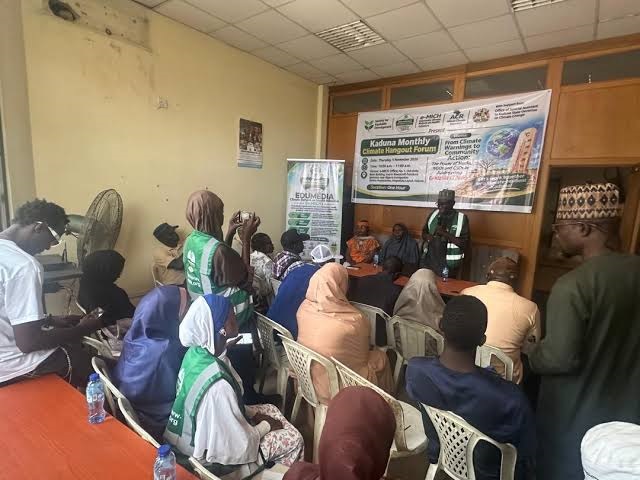
They made the call at the end of November edition of the Kaduna Monthly Climate Hangout Forum, which brought together field scientists from academic and research institutions, geologists, medical professionals, environmental journalists, non-governmental organisations, traditional and faith-based leaders, community representatives and disaster management experts.
The participants stressed that addressing the potential threats of El Niño requires more than scientific warnings, urging government agencies, research institutions, the media, NGOs and community organisations to work together to ensure that reliable climate information reaches the general public, particularly vulnerable populations.
The one-day gathering was organised by African Climate Reporters (ACR), in collaboration with the Society for Equitable Development ,and E-MiCH (EduMedia Climate Reform on Health Initiative), with support from Green Climate Africa.
Held under the theme, “From Climate Warnings to Community Action: The Power of Media, NGOs and CSOs in Addressing Godzilla El Niño,” the forum focused on strengthening partnerships and identifying practical approaches to climate communication, public education and community preparedness.
Speaking at the event, the Head of Communication and Strategies at African Climate Reporters, Ibrahima Yakubu, said there was an urgent need for all stakeholders to combine their efforts in developing effective strategies to educate the public about the potential dangers of El Niño.
He explained that collaboration among government agencies, scientists, health professionals, environmental organisations, civil society groups, research institutions and the media would help ensure that accurate and timely climate information reaches communities before extreme weather conditions occur.
Yakubu noted that while scientists and research institutions have a responsibility to provide reliable climate information and early warnings, the media must translate complex scientific findings into simple, accessible messages that ordinary people can understand and act upon.
He added that civil society organisations and community-based groups should take climate awareness campaigns to grassroots communities, particularly farmers, women, young people and other vulnerable populations who may face greater risks from climate-related impacts.
Delivering a presentation, Hajiya Halima Haruna, a geophysicist, academic and researcher, and lecturer in the Department of Mineral and Petroleum Resources Engineering at Kaduna Polytechnic, highlighted practical measures individuals, households and communities could adopt to minimise the potential impacts of a strong El Niño.
She explained that although El Niño is a natural climate phenomenon that cannot be prevented, its potential consequences could be reduced through early preparation, access to reliable weather information and collective action.
Among the measures she highlighted were strengthening early-warning systems, conserving water, adopting climate-smart agricultural practices, planting drought-resistant crops, preventing indiscriminate bush burning and protecting vulnerable populations against extreme heat.
She also emphasised the importance of providing communities with timely weather forecasts and climate information to help them prepare for possible droughts, flooding, water shortages and other climate-related challenges.
Similarly, Mallam Garba Mohammed, founder of E-MiCH (EduMedia Climate Reform on Health Initiative), emphasised the media’s responsibility in educating and preparing the public for the potential impacts of El Niño.
He called on journalists to strengthen their working relationships with scientists, meteorological agencies, health professionals and environmental organisations to ensure that accurate early-warning information and preventive messages reach the public.
According to him, radio, television, newspapers, social media and local-language programmes remain important channels for combating misinformation, promoting public understanding and encouraging communities to take preventive action.
Also speaking, Comrade Salim Musa Sulaiman, State Coordinator of the Global Environmental and Climate Conservation Initiative, highlighted the important contribution of non-governmental organisations to grassroots climate awareness and community preparedness.
He said NGOs should intensify public sensitisation, climate education and community engagement while working closely with government agencies, scientists, journalists and local organisations to disseminate reliable information and promote practical preventive measures.
He further stressed that grassroots organisations have an important role in ensuring that vulnerable communities are not left behind in climate awareness and preparedness efforts.
The participants maintained that preparing for the potential impacts of a strong El Niño should not be the responsibility of government agencies or meteorological institutions alone.
They called for sustained partnerships among scientists, the media, NGOs, civil society organisations, health professionals and community leaders to transform climate information into practical action, protect vulnerable populations and strengthen Nigeria’s resilience to climate-related challenges.