





A new report released by the United Nations Development Programme (UNDP) has revealed that eight northern states—Kebbi, Yobe, Sokoto, Jigawa, Zamfara, Gombe, Borno, and Bauchi —suffer from the highest multidimensional poverty rates in Nigeria. The data underscores a troubling geographic disparity, showing that severe socioeconomic hardship remains increasingly concentrated in the country’s northern region. According […]
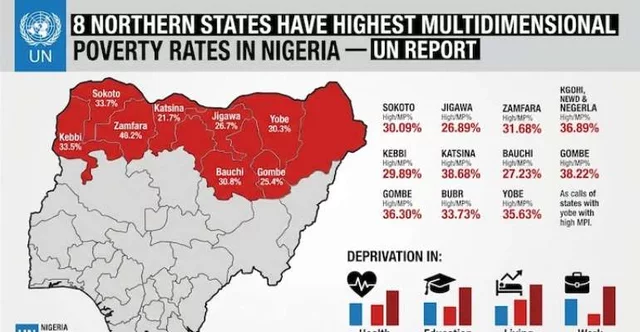
A new report released by the United Nations Development Programme (UNDP) has revealed that eight northern states—Kebbi, Yobe, Sokoto, Jigawa, Zamfara, Gombe, Borno, and Bauchi —suffer from the highest multidimensional poverty rates in Nigeria. The data underscores a troubling geographic disparity, showing that severe socioeconomic hardship remains increasingly concentrated in the country’s northern region.
According to the 2026 Global Multidimensional Poverty Index (MPI) , which was jointly published by the UNDP and the Oxford Poverty and Human Development Initiative (OPHI) , Kebbi, Yobe, and Sokoto recorded the absolute highest levels of poverty nationwide. This tier of severe deprivation is closely followed by Jigawa, Zamfara, Gombe, Borno, and Bauchi , indicating a widespread lack of access to basic healthcare, education, and standard living conditions across these states.
In stark contrast, southern states performed significantly better in the index, highlighting a deep regional divide. Lagos recorded the lowest overall poverty value in the federation, while Edo and Rivers were also ranked among the states closest to the bottom of the deprivation index, demonstrating vastly better socioeconomic outcomes than their northern counterparts.
The newly released index highlights a staggering inequality across the federation, with the overall Multidimensional Poverty Index (MPI) value ranging sharply from a low of 0.014 to a high of 0.557 . This vast discrepancy translates directly to the population level, where the proportion of citizens living in acute deprivation spans from a mere 3.7% in the least affected areas to a devastating 88.3% in the hardest-hit states .
Given these wide gaps, the joint report explicitly warns that Nigeria’s escalating crisis cannot be resolved with a single, uniform national formula. Because the core drivers of deprivation now differ so drastically from one state to another, the authors emphasize that federal and state governments must urgently implement tailor-made, localized economic policies to effectively address specific regional needs.
The human cost of this crisis is immense, as approximately 90 million Nigerians are now trapped in multidimensional poverty, completely cut off from basic necessities such as proper nutrition, education, electricity, clean water, and decent housing. This internal decline is part of a broader trend, as Nigeria recorded the world’s largest absolute increase in multidimensional poverty between 2021 and 2024, plunging an additional 17.9 million people into poverty—far outpacing Afghanistan, which followed with an increase of 5.3 million.
Based on the report’s harmonised metrics, Nigeria’s multidimensional poverty rate escalated from 33% in 2021 to 38.7% in 2024 , pushing the total number of impoverished citizens from 72.21 million to 90.07 million . This downturn is mirrored in the nation’s overall MPI score, which climbed from 0.175 to 0.208 , demonstrating that the daily deprivations faced by citizens have significantly intensified.
This sharp decline marks a severe reversal of the steady progress Nigeria recorded between 2018 and 2021. With this downturn, the country has become one of only five nations globally where poverty rates worsened during the latest evaluation window, joining Afghanistan, the Central African Republic, Guinea, and Kyrgyzstan .
Alternatively, a separate unadjusted 2024 survey estimate—which employs a different methodology and cannot be used interchangeably with the historical data—presents an even starker picture, placing the poverty figure at 113.32 million people , or 48.7% of the population . Under this specific lens, 28.7% of the population survives in severe multidimensional poverty, while another 18.1% remains dangerously vulnerable to slipping below the threshold.
When breaking down the core drivers of this crisis, deficient living standards emerge as the largest contributor, accounting for 40.6% of Nigeria’s total poverty value, followed closely by education at 30.6% and health at 28.8% . The structural deficit is further illustrated by specific infrastructural gaps: 37.6% of Nigerians completely lack access to clean cooking fuel, 31.3% are cut off from electricity, and 28.5% live without adequate housing.
The UN report stresses that mapping exactly where specific deprivations are concentrated is essential for transforming abstract poverty statistics into effective, localized action. It highlights that states with nearly identical poverty rates often face entirely different structural challenges ; for instance, Yobe State is primarily weighed down by poor nutrition and high child mortality, whereas Sokoto State is driven into deeper poverty by a severe lack of access to clean water and electricity. Because these deprivation patterns vary so drastically both across and within national borders, subnational data is absolutely vital for designing interventions that respond to local realities.
To capture these complexities, the Multidimensional Poverty Index (MPI) differs from traditional income-based measures by tracking overlapping deprivations across health, education, and living standards. It evaluates households using 10 core indicators , including nutrition, child mortality, years of schooling, electricity, sanitation, and housing, classifying an individual as poor if they are deprived in at least one-third of these weighted metrics.
On a global scale, the report paints a grim picture, revealing that 1.2 billion people —representing 18.9% of the population across 108 surveyed countries—currently live in acute multidimensional poverty. Sub-Saharan Africa bears the brunt of this crisis, accounting for 616 million impoverished individuals (more than half of the global total), while children make up a staggering 617 million of the world’s poor. Despite these sobering numbers, the report offers a glimmer of hope, noting that 33 countries successfully halved their MPI values in under 15 years—including six in Sub-Saharan Africa—proving that rapid, transformative progress is entirely possible when backed by targeted policies.